About the programme

About the AIR Observatory

The Observatory studies Algorithmic Immersion Radicalisation as a possible socio-technical pathway through which digital environments can intensify grievance, identity conflict, emulation and mobilisation.

The central proposition

AIR is not a new ideology and it is not a claim that social media, algorithms or artificial intelligence alone cause violence. It is a structured way to examine how repeated, curated and socially reinforced online exposure may interact with ideology, personal grievance, group identity, trigger events and offline circumstances.

The programme brings together governed case files, selected Five Eyes social-context data, evidence ratings and transparent exploratory analysis. It is built for teaching, public education and careful research discussion.
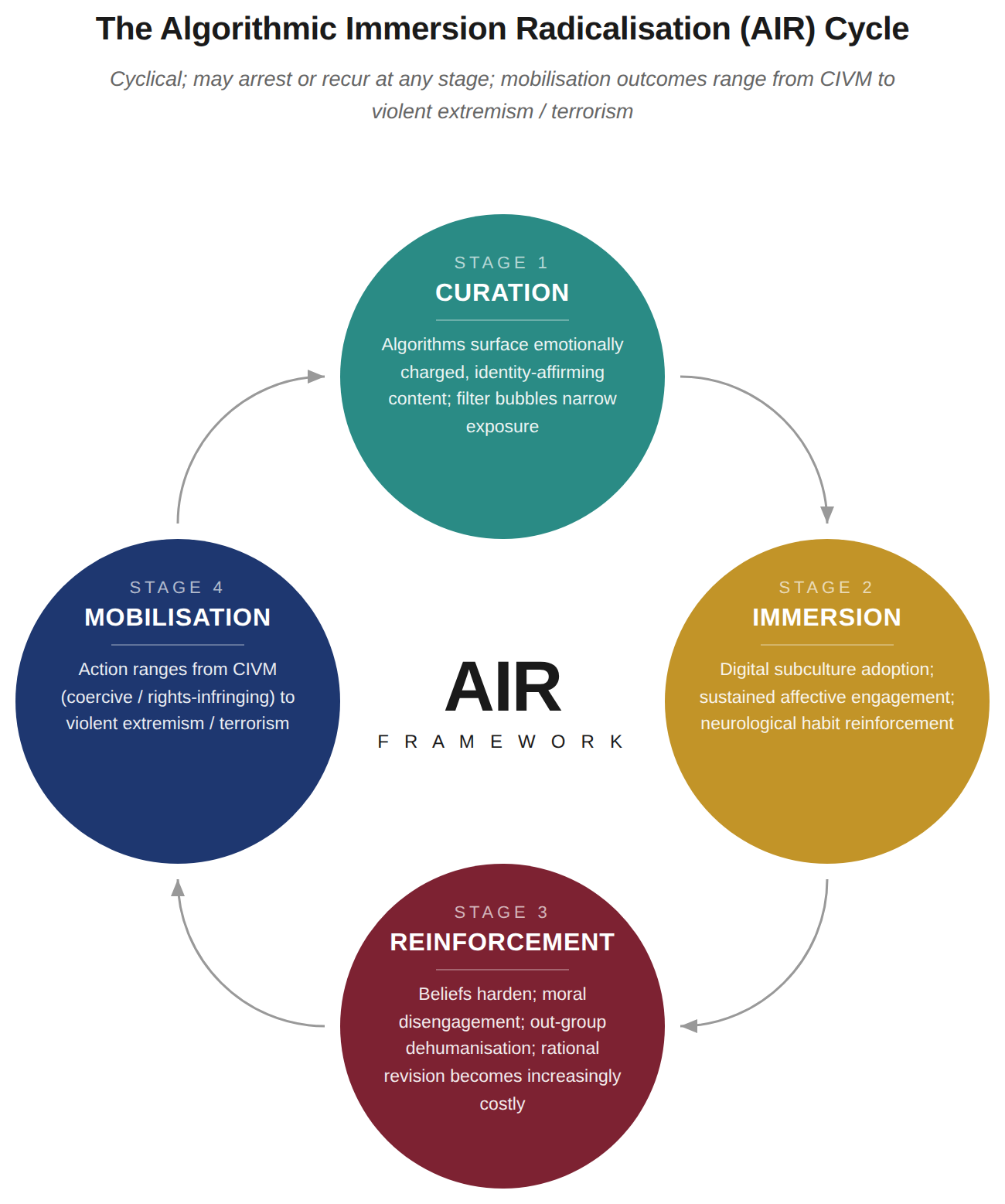
AIR cycle linking immersion, reinforcement, grievance and mobilisation
The AIR cycle is a conceptual framework. It should be tested against documented evidence rather than treated as settled causation.

Framework

Three connected levels of analysis

01

Case pathway

What public sources document about online influence, repetition, networks, planning, emulation, manifestos, livestreaming and notoriety.

02

Digital environment

Internet access, time online, social-media use, recommendation systems, platform design and information concentration.

03

Social context

Demographic, economic, health, crime, justice, trust, cohesion and strategic conditions used cautiously as background context.

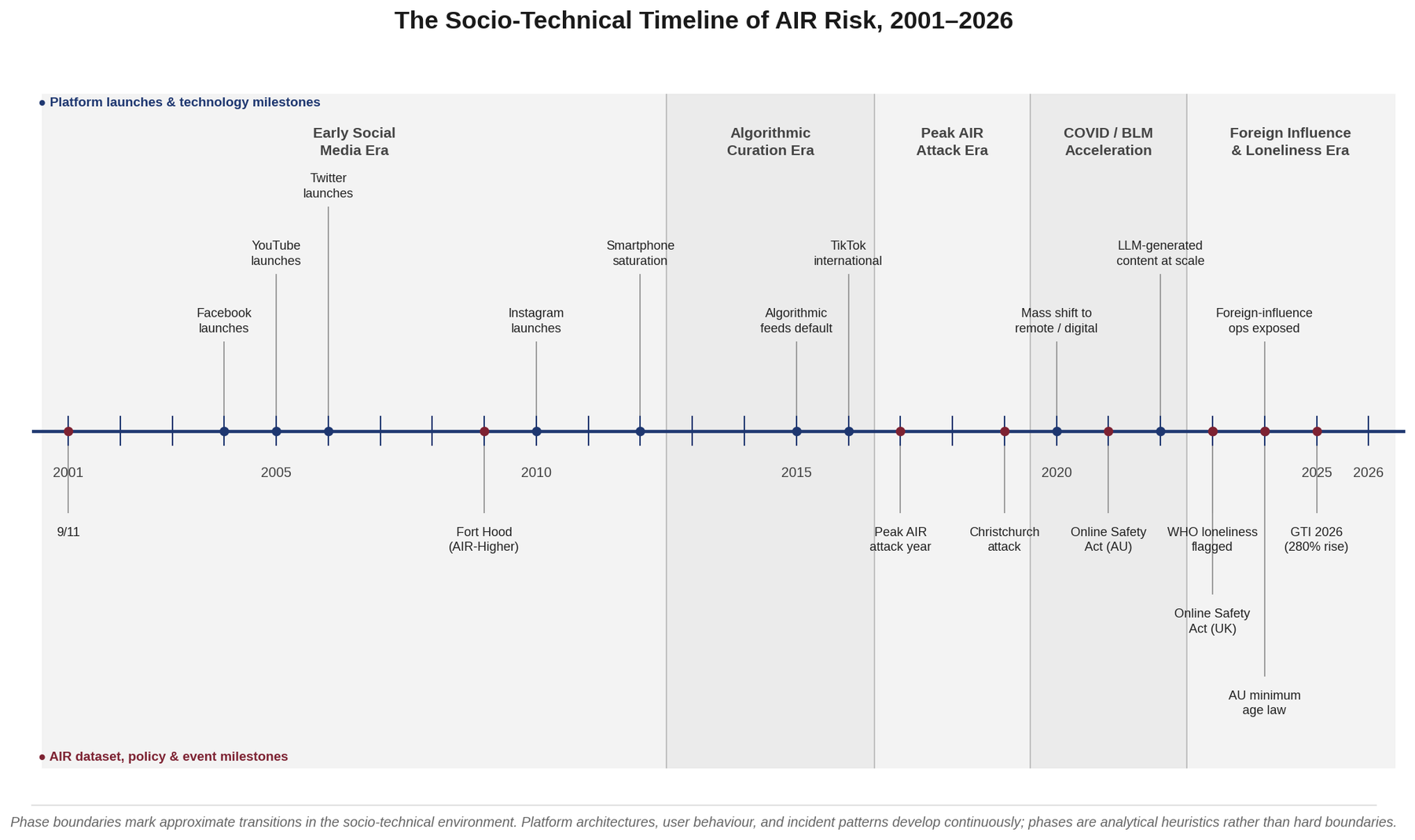
Socio-technical timeline of AIR-relevant digital developments

Teaching and public education

The Observatory helps students distinguish description, correlation, temporal association, plausible mechanism and causal proof. Presentation View enlarges analytical displays for classrooms and public talks.

Future research agenda

Priorities include stronger case-level pathway evidence, transparent event-window studies, comparable youth and digital-life data, sensitivity testing, and formal validation of educational measures before they are used as research instruments.

Author and project lead

Kelly W. Sundberg, PhD

Professor of Criminology, Mount Royal University. Adjunct appointments: De Montfort University—Solution Oriented Policing Group; Adelaide University—Law; University of Calgary—Schulich School of Engineering.

LinkedIn profile

Research support

Alannah Reynaud, BA (Hons)

Recognised for research support and contributions to the continuing development of the AIR programme.

LinkedIn profile

Acknowledgements

The AIR Observatory gratefully acknowledges continuing collegial support from the Solution Oriented Policing Group at De Montfort University, Law at Adelaide University, and the Schulich School of Engineering at the University of Calgary. Responsibility for the Observatory’s content and conclusions remains with its author; acknowledgement does not imply formal institutional endorsement.

Future public scholarship may include a contribution to The Conversation Canada, subject to editorial acceptance and any applicable ethical requirements.